How a Program Built on Goodwill Works
In the mid-1980s, something that sounds almost quaint began happening in rural Montana: landowners started talking to biologists. Not fighting them, not lawyering up over trespass disputes — talking. Local ranchers and FWP field staff worked out informal arrangements to manage hunting pressure on private land and give public hunters somewhere to go. There were no contracts, no formal payments, no government infrastructure. Just working relationships.
That informal network became the foundation of Montana's Block Management Program. When the 1995 Legislature authorized FWP to formally compensate landowners for allowing public access, the program scaled quickly. By the 1996 hunting season, it had real teeth: a payment structure, signed agreements, and a map that hunters could actually use. Within six years, at peak enrollment in 2002, 1,150 landowners had opened more than 8.8 million acres of private land to free public hunting.
That number — 8.8 million acres — is worth sitting with. It is a staggering act of public-private cooperation in a state where landowner-hunter tension is real and the pressure on private land has only grown.
How It's Funded, and Why That Matters
The Block Management Program does not run on general tax revenue. It runs on hunters.
Funding comes primarily from nonresident deer and elk licenses, Native Montana licenses, proceeds from the Super Tag Lottery, private donations, and — critically — Pittman-Robertson federal excise tax funds, which are generated by purchases of firearms, ammunition, and archery equipment. Every box of centerfire rifle ammo a hunter buys anywhere in the country generates federal excise tax that flows to state wildlife agencies for exactly this kind of work.
Resident hunters contribute directly through their base license fee: $2 of every Montana resident hunting license goes into the hunter access fund. In 2024, FWP was paying a total of $12.3 million annually to enrolled landowners — an enrollment payment of $1,000 per property plus a "hunter day rate" of $17 per day a hunter spends on that land, up to an agreement maximum of $50,000.
That is hunters funding access to private land — the most direct expression of the North American Model of Wildlife Conservation you will find anywhere.
What the Program Looks Like on the Ground
Today the program enrolls roughly 1,200 landowners covering approximately 6.8 million acres. That decline from the 8.8 million-acre peak matters and is discussed honestly below. But first, here is how it actually functions.
Each fall, FWP publishes BMA maps by region on its website (fwp.mt.gov). The maps show enrolled properties with color-coded access types:
- Walk-in access: Show up, sign in at the box, hunt. No call required.
- Permission required: Contact the landowner directly before hunting. Some require you to register a vehicle; some want to know how many hunters are in your party.
- Quota properties: Limited to a set number of hunter parties per day or season. Some of the best properties fall into this category — which is a signal, not a deterrent.
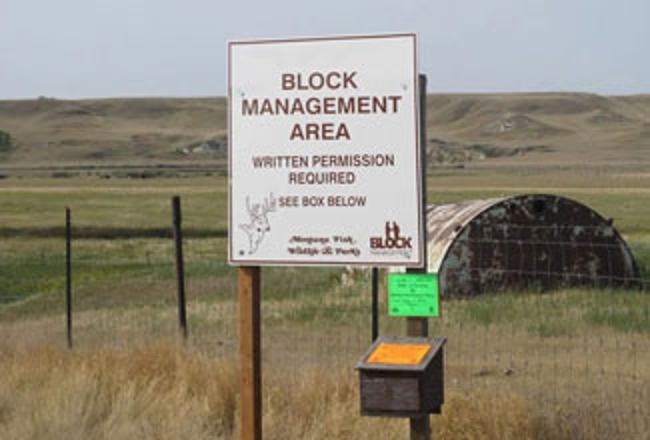
Sign-in boxes are a legal requirement at all BMAs. Sign in every time. That data feeds directly into the program's justification for continued funding — if boxes are empty, FWP has a harder case to make to the Legislature.
If you've hunted Block Management properties in Montana, post your observations on the unit page for the hunting district you were in. Notes on access, species seen, and property conditions help other hunters find the real gems. Browse Montana hunting districts →
Species Available
The program covers a genuinely wide range of hunting:
Whitetail and mule deer are the most commonly available species across BMA properties. Eastern Montana's river breaks and ag country produce some of the best whitetail hunting in the state on properties that would otherwise be off-limits.
Elk are available on mountain-adjacent BMAs, particularly in Regions 1, 2, and 4 in western Montana. Some of these properties adjoin or connect to National Forest, providing access to elk that move between public and private land.
Pronghorn dominate on the open prairie properties of central and eastern Montana — Regions 6 and 7, which together account for nearly 3.5 million of the program's total enrolled acres.
Upland birds — pheasant, sharp-tailed grouse, Hungarian partridge — are a major draw on agricultural BMAs in the Hi-Line and eastern Montana. Some hunters use the program almost exclusively for bird hunting.
Waterfowl access is available on some properties with ponds, reservoirs, and river frontage, though this varies significantly by property and year.
The Honest Assessment: Quality Varies Wildly
This needs to be said plainly: not all Block Management properties are equal, and some are not worth your time.
High-pressure properties near population centers — particularly those with easy highway access and walk-in sign-in — can get hammered early in the season. By late October, some of these properties have been hunted hard enough that deer and elk pressure-train onto them and go primarily nocturnal. A property that looks great on the map in August may be a bust by second rifle season.
Conversely, quota properties and remote walk-in BMAs in less-traveled counties can be exceptional. Region 7 in eastern Montana, with 251 BMAs covering over 2 million acres, has a reputation for low hunting pressure relative to the land available — if you're willing to drive past the convenient options.
The hunters who get the most out of Block Management treat it like any serious scouting exercise. They look for properties adjacent to unhunted public land. They call landowners on permission-required properties early — September or earlier — and have a real conversation about the land and what they hope to find. They understand that the sign-in box is a relationship, not just a formality.
A Program Under Pressure
The enrollment decline is real and worth understanding. From 8.8 million acres in 2002 to 6.8 million in 2025 — a 23% drop over two decades — despite FWP doubling the payment cap and increasing the hunter day rate. Meanwhile, hunter demand has increased from roughly 250,000 hunter-days recorded in 1999 to close to 700,000 hunter-days in 2024.
More hunters. Less land. The math is uncomfortable.
The reasons for landowner withdrawal are multiple: new ranch owners who bought property specifically for private hunting and have no interest in public access, a general erosion of trust in government programs, concerns about losing management control, and the rising value of hunting leases that make $17 per hunter day look trivial by comparison.
FWP is actively working to reverse the trend, and the Legislature has shown willingness to increase program funding. But the long-term health of Block Management depends on something FWP cannot mandate: genuine goodwill between hunters and the people who own Montana's private land.
That goodwill is not a given. It is built or destroyed one interaction at a time — at sign-in boxes, along fence lines, in the way you leave a property.
Hunted a Block Management area this season? Your report on the relevant hunting district page helps other hunters find the real properties — and helps make the case that the program is worth keeping. Browse Montana hunting districts →