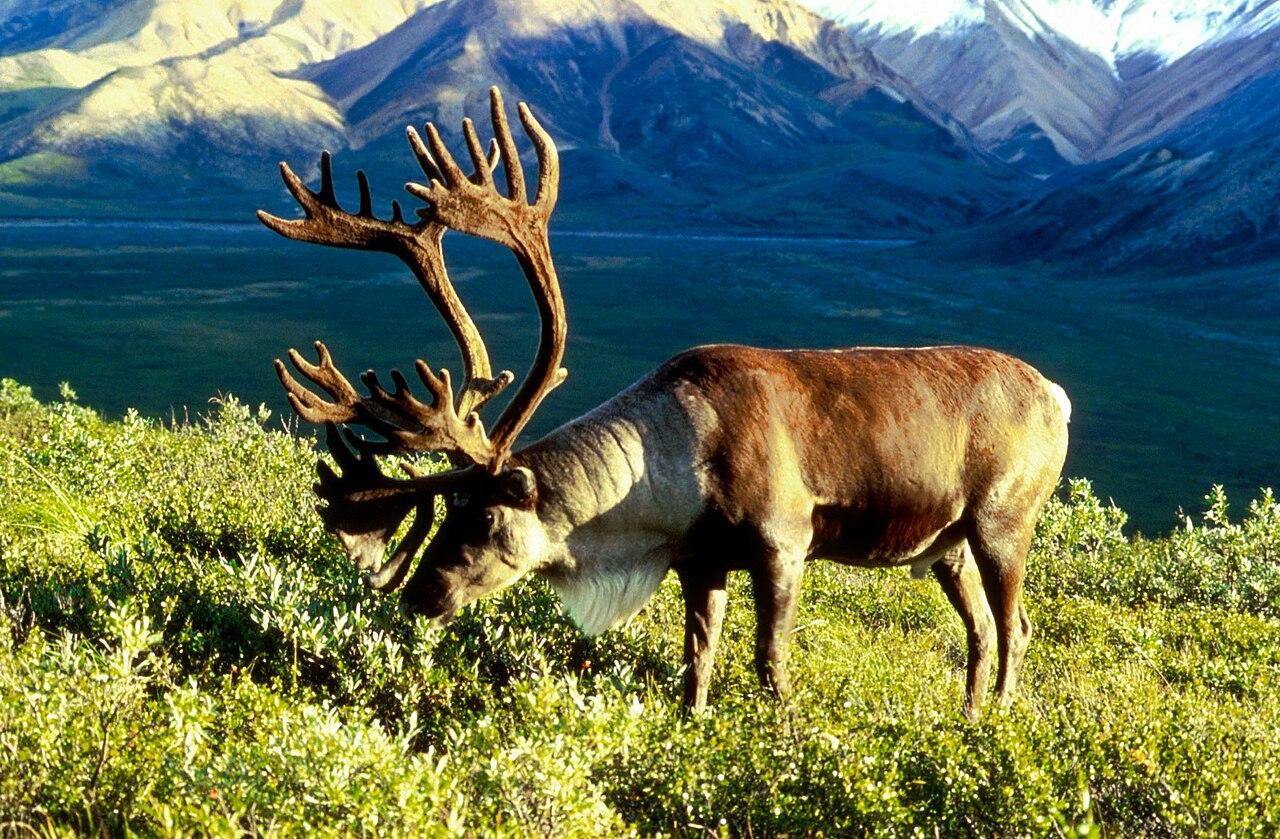
Caribou
Rangifer tarandus · Cervidae
The migration hunters — hundreds of thousands of caribou crossing Alaska's tundra in one of the world's great wildlife spectacles.
Found & hunted in
Overview
Caribou are the only deer-family member in which both sexes regularly grow antlers. They are the dominant large herbivore across Alaska's arctic and subarctic tundra, migrating hundreds of miles seasonally between calving grounds and winter range. Hunting caribou, particularly in Alaska's interior or along the Arctic coast, is an extraordinary wilderness experience. Both resident and non-resident hunters can take caribou in Alaska, making it one of the few true big-game self-guided opportunities that doesn't require a guide.
Habitat
Caribou (Rangifer tarandus) are defined by movement more than any other North American ungulate — their habitat is not a place but a seasonal progression across some of the most extreme environments on the continent. No other large mammal migrates farther in North America than caribou, with some Barren-ground herds traveling 3,000+ miles annually between calving grounds on the Arctic tundra and wintering areas in the boreal forest hundreds of miles to the south.
Summer tundra habitat for migratory caribou consists of wet sedge tundra dominated by cottongrass (Eriophorum angustifolium, E. vaginatum), sedges (Carex spp.), tussock-forming sedge communities, and the dwarf shrubs — dwarf birch (Betula nana), willow (Salix spp.), crowberry (Empetrum nigrum), and Labrador tea (Rhododendron groenlandicum) — that dominate mesic to dry Arctic tundra. Calving grounds are typically flat, open tundra near the Arctic coast or on elevated, wind-swept ridges where insect pressure is minimized and predator visibility maximized. Cows and calves benefit from strong winds that reduce insect harassment, a factor so significant it actually influences calving ground selection — calving areas in documented studies are demonstrably windier than surrounding terrain.
Summer feeding focuses on the flush of nutritious forbs and graminoids available during the brief Arctic growing season. Cotton grass flower heads and leaves, dwarf birch catkins, willowherb (Epilobium spp.), and sedge rhizomes form the primary diet. Caribou in summer gain weight rapidly to support pregnancy, lactation, and antler growth simultaneously — the remarkable physiological feat that defines this species.
Winter habitat moves south into the boreal forest (taiga), where deep snow is the defining challenge. Caribou locate terrestrial lichens — Cladonia stellaris, Cladonia rangiferina (reindeer lichen), and numerous other species — by smell through the snow, excavating craters (called feeding craters or "cratering") to access the lichen mats beneath. These lichens represent low-quality, slow-to-recover forage: the boreal lichen mats that support wintering caribou require 40–80 years to recover after heavy use, meaning overwintering pressure in restricted areas can degrade habitat for generations. Mountain caribou (the southern mountain populations) use dramatically different winter habitat — relying on arboreal lichens (Bryoria spp., Alectoria sarmentosa) hanging from old-growth subalpine fir and Engelmann spruce rather than ground lichens, making old-growth forest an absolute requirement for their winter survival.
Population
The continental caribou population has experienced one of the most dramatic and troubling declines of any North American ungulate over the past three decades. Peak estimates in the 1990s put the total continental population at approximately 4.7 million animals; current estimates range between 2.1 and 2.9 million — a decline of 40–50% in roughly 30 years. The Bathurst herd in Canada's Northwest Territories declined from 500,000 animals to fewer than 20,000 over a 20-year period. The George River herd in Quebec-Labrador — once the largest caribou herd on earth at 800,000+ animals — collapsed to fewer than 9,000 animals by 2018. Some populations have stabilized or shown limited recovery, but the continental trend remains deeply concerning.
Alaska's Barren-ground herds have shown more variability and somewhat less catastrophic decline. The Western Arctic herd, Alaska's largest, peaked at approximately 490,000 animals in 2003 before declining to approximately 190,000–220,000 by the late 2010s, then showing some stabilization. The Porcupine herd has remained more stable at 160,000–220,000 animals, though its calving grounds in the Arctic National Wildlife Refuge remain a subject of intense political controversy regarding energy development. The Central Arctic herd maintains approximately 30,000–40,000 animals and has been the subject of significant research regarding oil field impacts in the Prudhoe Bay area.
The causes of caribou population declines are multiple, interactive, and still not fully understood. Climate warming is almost certainly a primary driver — changes in the timing of vegetation green-up relative to calving affect calf nutrition and survival; rain-on-snow events that lock terrestrial lichens under an impenetrable ice crust produce winter starvation events; shrubification of the tundra as warming allows shrub species to colonize previously graminoid-dominated terrain alters habitat quality. Predation pressure from wolves and bears, while natural, may be amplified in disrupted systems. Industrial development — roads, pipelines, and associated human activity — causes behavioral avoidance reactions that can push caribou away from preferred habitat, reducing foraging efficiency even when direct mortality is not involved.
Conservation
Caribou conservation represents one of the most complex governance challenges in North American wildlife management, crossing multiple international, national, provincial, and indigenous jurisdictional lines. The Porcupine Caribou Management Board, established under the 1987 Porcupine Caribou Management Agreement between Canada and the United States, represents the most prominent international cooperative management effort — involving federal agencies of both nations, the governments of Yukon and Northwest Territories, and the indigenous First Nations and Alaskan Native organizations whose cultural and subsistence relationships with the Porcupine herd span millennia.
Indigenous rights and subsistence hunting are fundamental to any honest discussion of caribou conservation. For dozens of First Nations, Inuit, Métis, and Alaska Native communities across the caribou range, caribou represent not merely a food source but the organizing principle of culture, ceremony, seasonal movement, and identity accumulated over thousands of years. The 2003–2010 collapse of Bathurst herd numbers prompted closures of sport hunting well before subsistence harvest was restricted, reflecting both the ethical and legal primacy of indigenous subsistence rights and the recognition that sport hunting harvests were minor relative to subsistence and predation mortalities. Any responsible caribou hunting program must operate within a framework that acknowledges these realities.
Conservation organizations working on caribou include the Caribou Conservation Collaborative, the Wildlife Conservation Society's Arctic programs, the Boreal Songbird Initiative (which advocates for the old-growth boreal forest that supports multiple caribou populations), and numerous First Nations organizations conducting co-management research. Canada has listed woodland caribou (the boreal population of southern mountain caribou) as Threatened under the Species at Risk Act, triggering recovery planning requirements across provinces — though implementation has been slow and contested by the forestry industry. Habitat protection for calving grounds remains the most debated policy lever, with the Porcupine herd's Arctic Refuge calving grounds and the mountain caribou's old-growth forest needs representing the sharpest conservation flashpoints in North American wildlife policy.
Subspecies
The most numerous and most widely hunted caribou subspecies. Alaska provides the most accessible legal sport hunting opportunity; Canadian barren-ground caribou hunting has been significantly restricted due to population declines in major herds.
The southern mountain caribou population in British Columbia is listed as Threatened under Canada's Species at Risk Act and has been closed to hunting. Northern mountain caribou hunting is available in Yukon Territory, NWT, and Alaska. The Selkirk Mountains population (extending into Idaho and Montana) represents the only woodland/mountain caribou extant in the contiguous United States.
Classified by some authorities as a distinct subspecies (Rangifer tarandus granti) and by others as part of the barren-ground complex. Boone and Crockett records barren-ground and Grant's caribou in the same category. Alaska's Alaska Peninsula caribou provides some of the most geographically dramatic caribou hunting in North America.
Diet
Highly seasonal. Summer: sedges, grasses, forbs, mushrooms (high calorie density). Fall/winter: lichens (reindeer moss) — a low-quality but abundant food source that caribou excavate from under snow with their hooves. They are uniquely adapted to digest lichens.
Social Behavior
The most migratory ungulate in North America. Herds (some numbering 500,000+) make seasonal movements of 300–500 miles. Individual caribou within a migrating herd travel at a quick walk for hours. Outside migration, smaller groups form based on sex and age. The caribou's clicking sound when walking is tendons snapping in the foot joints — the basis of theories for why they evolved this: herd coordination in whiteout conditions.
Breeding & Rut
Rut peaks in October. Bulls are in hard antler, with necks swollen, and actively compete for cows. Fights involve antler wrestling. Mature bulls (6+ years) hold harems and breed the most cows. Post-rut, bulls are exhausted and shed antlers; cows retain antlers through winter to maintain feeding access under snow.
Scouting
- →Caribou scouting is fundamentally different from deer or elk scouting because the animals move — sometimes 20–30 miles per day during migration. Rather than scouting specific locations animals occupy, you're scouting migration corridors, traditional crossing points, and the environmental features that concentrate moving herds. Study decades of migration records from state and provincial wildlife agencies, speak with local guides and Indigenous residents about traditional herd movement patterns, and build contingency plans for where caribou might be if the primary corridor shift.
- →Identify natural crossing points on rivers and lakes that compress migrating herds. Caribou following traditional migration routes cross the same rivers at the same locations used for generations — and these crossing points, where the river shallows or narrows, are where ancient and modern hunters alike position themselves. Find these crossings using topographic maps and aerial imagery, noting the locations of gravel bars, shallow riffles, and the game trails converging on water from both banks.
- →Glass elevated terrain in the direction of known migration to spot approaching herds before they reach your position. In open tundra, caribou are visible from remarkable distances — a herd of 500 animals moving across a ridgeline can be spotted at 8–10 miles with quality 10x42 binoculars. Position yourself on the highest available terrain in the direction animals approach from and scan methodically using binoculars for the characteristic movement of dozens to hundreds of animals moving in loose, flowing columns.
- →Study wind patterns in mountain caribou country carefully before attempting stalks. The stable thermal systems that develop in mountain valleys during clear weather — upslope thermals by mid-morning, downslope flows in late afternoon — are predictable and can be used to maintain scent advantage during multi-hour stalks on stationary or slowly moving bands. Mountain caribou in the absence of insects often bed on high ridgelines and wind-swept terrain where they can monitor approaches and thermals simultaneously.
- →Use trail cameras on river crossings and known travel corridors to document herd timing before or during multi-day hunts. In country where herds may take days to arrive after initial scouting reveals them approaching, camera data builds confidence in herd movement timing and provides intelligence on bull-to-cow ratios and the presence of mature bulls with exceptional antlers.
- →Locate lichen-rich terrain in your hunting area on aerial imagery — lichens appear as pale gray or white patches on tundra surfaces visible in fall satellite imagery. Caribou target these areas both in fall migration and as wintering concentrations. In areas where migration routes are uncertain, lichen-rich ridges and plateaus often serve as staging areas where animals slow down and feed before continuing movement.
- →Time your hunt to match herd location. In many caribou hunting areas, the difference between hunting during the main migration versus hunting before or after the herd passes is the difference between encountering hundreds of animals daily and hunting empty tundra. Work with local guides and wildlife managers to understand average migration timing for your specific unit and build flexibility into your schedule to accommodate inter-annual variability of 2–3 weeks in migration timing.
- →Scout for bull groups separate from cow-calf herds in August. Prior to and during the early rut (late August through early September for most barren-ground caribou), bulls travel in bachelor groups that often range ahead of or to the sides of the main cow migration. These bachelor groups are hunting gold — concentrated mature bulls in pre-rut condition before the rutting stress that strips body condition.
- →Identify eskers, ridges, and elevated terrain used as insect-relief areas in late July and August. When mosquitoes and black flies peak, caribou seek wind, elevation, and remaining snow patches that provide insect respite. Bulls especially concentrate on exposed ridgelines and snowfields in late summer, making these locations reliable for late-August hunting that precedes the main migration.
- →Learn to read caribou body language to determine travel intention and pace. A herd with heads down feeding is in no hurry and provides time for careful positioning. A herd moving with heads up and steady pace is in migration mode — it may cover 10 miles before stopping, and stalking toward it will be futile unless you can position ahead of its travel line. A herd that has spotted you at distance will mill, may approach out of curiosity (a characteristic caribou behavior), or may divert significantly — knowing which response to expect based on wind direction and initial herd reaction is critical to decision-making.
- →Mark GPS waypoints for every notable terrain feature in your hunting area: river crossings, lichen flats, elevated glassing vantage points, potential camp locations near water, and helicopter or floatplane landing areas if applicable. Caribou hunting in remote tundra requires exact navigation in weather that can reduce visibility to yards, and knowing your terrain from pre-hunt study can prevent disorientation that costs hunting time.
Gear & Calibers
Hunting Tips
- →In Alaska, caribou don't require a guide for non-residents. This makes caribou hunting one of the best self-guided remote hunting opportunities on the continent.
- →Intercept migrating herds — talk to local pilots and ADF&G about migration timing and routes. Timing varies year to year.
- →Float trips along rivers in prime caribou country offer both transportation and hunting access.
- →Select a bull carefully — antler quality varies enormously. Look for long brow palms (shovels), tall main beams, and distinct bez tines.
Stalking Tips
- →Caribou on migration often walk toward you — patience and positioning beat active stalking.
- →On open tundra, any movement is visible. Crawl the final distance if needed.
Glassing Tips
- →Glass tundra river crossings, ridge systems, and valley floors. A migrating herd is unmistakable — thousands of animals moving in a line.
- →Look for antlers above the tundra — swaying velvet in early season or hard antlers in October are visible at long distance.
Trophy Judging
- →The defining characteristic of a trophy caribou bull is the double shovel — the broad, palmated brow tines that develop into opposing shovel-like structures over the face in older, fully mature bulls. A bull with well-developed double shovels carries an additional 40–80 inches of B&C score from those structures alone. The presence of any palmation on both brow tines immediately marks a bull as worth evaluation; full double shovels on a bull with otherwise average antlers can produce a respectable record book score.
- →Count brow tine points and bez points as the primary scoring elements after palmation. A bull's brow tines ideally carry multiple distinct tines projecting from a broad palm base — count these methodically from your glassing position. Similarly, the bez (second tine or 'rear shovel') develops palmation in mature Barren-ground bulls; a well-developed bez palm matching the brow palm marks an exceptional individual.
- →Judge main beam length by comparison to body dimensions. A mature barren-ground bull stands approximately 4.5 feet at the shoulder; main beams that sweep back and up to equal or exceed shoulder height are in the 50+ inch range. The sweeping S-curve of caribou main beams makes direct measurement difficult from field positions — focus instead on how far the beams project above and behind the body silhouette.
- →Evaluate top points (the multiple tines projecting from the main beam near the top) carefully through your spotting scope. A bull with 10–15 distinct top points on each antler carries enormous raw measurement into the scoring formula — each long top tine may measure 8–15 inches. In the field at distance, a bull whose top portion of antlers appears 'bushy' or 'fanned' with multiple distinct projections is worth more careful evaluation.
- →Know the Boone and Crockett minimums for your target subspecies: Barren-ground caribou (which includes Grant's caribou) minimum is 400 points; Mountain caribou minimum is 390 points; Central Barren-ground caribou (if hunting separate classifications) follows similar thresholds. Pope and Young archery minimums are 265 points for barren-ground and mountain. Most fully mature bulls with complete double shovels, well-developed top points, and decent beam length will approach or exceed these thresholds.
- →Assess symmetry versus adding up total mass. Unlike elk, where asymmetry substantially reduces score, caribou antlers are often significantly asymmetric — one side may carry more brow shovel development, more top points, or more length. The Boone and Crockett scoring system for caribou measures each side independently and adds them (rather than using the elk/deer system of doubling the smaller side), meaning a bull with one outstanding side and one average side can still score very well. Don't immediately dismiss a bull for obvious asymmetry.
- →Focus evaluation time on bulls that are stationary or feeding rather than moving animals. A bull in full rut moves constantly — shifting direction, displaying, thrashing vegetation — making systematic point-counting and measurement comparison nearly impossible. Bulls feeding on lichen during staged migration are often calmer and provide better evaluation opportunity. If you locate a bull worth evaluating, resist the urge to rush toward a shot; a few extra minutes of careful glassing is worth more than frantic decision-making during an approach.
- →In multi-bull herds during migration, use the comparison method rather than absolute judgment. Identify the largest bull in the herd and compare all others to him; identify the second-largest and compare downward. This relative evaluation is much faster and often more accurate than trying to estimate absolute measurements for each bull individually. If the largest bull in a 200-animal herd appears clearly exceptional relative to his companions, he deserves a stalk regardless of whether your absolute measurement estimates are precise.
Field Care & Dressing
- →Caribou are among the easier large game animals to field dress due to their relatively modest size compared to moose or elk, but speed still matters in warm late-summer conditions. A September caribou hunt in Alaska at 55°F ambient temperature gives you roughly 2 hours before surface bacteria begin growing on exposed meat — move efficiently through evisceration and begin cooling as soon as possible.
- →The caribou's hair coat is one of the most remarkable in North America — hollow individual hairs provide exceptional insulation but also trap heat in the carcass after death. Remove the hide as rapidly as possible after evisceration, especially in temperatures above 45°F. The hollow hair structure also makes hair contamination of meat a persistent problem — work carefully during skinning to prevent hair from contacting meat, and wipe exposed meat surfaces with a damp cloth if contamination occurs.
- →Caribou fat, particularly the subcutaneous fat that accumulates in thick deposits over the back, rump, and brisket in well-conditioned animals, has a distinctive waxy texture and mild flavor that is highly prized by experienced hunters. Unlike elk or deer fat, caribou tallow is pleasant-tasting and was historically a critical caloric component of indigenous diets (mixed with dried meat and berries to produce pemmican). Do not discard it reflexively — render it for cooking fat or leave it on the hindquarters during transport.
- →For multi-bull hunts where regulations permit harvesting two animals, establish a strict prioritization system for field care before the second bull is shot. Do not shoot a second animal until the first is fully cared for and either hanging or properly bagged — attempting to simultaneously manage two unprocessed animals in warm weather is a recipe for meat spoilage. The second animal should wait until you have capacity to handle it properly.
- →Protect the velvet antlers if shooting a bull still in velvet (typically pre-August 25 in most of the range). Bulls shoot in late August to early September often carry hardened, polished antlers; bulls taken in July and early August may still be in velvet or partially shed. Velvet antlers are fragile and puncture easily — transport with padding or wrap in clean burlap to prevent damage to a potential trophy mount.
- →In remote fly-in hunts, caribou meat must be packed to the aircraft in condition that will remain stable for the duration of the flight and any ground transport to the processing facility. Quarter, debone, and double-bag meat in breathable game bags, then place bags in a clean tarp or pack for transport. Ensure meat is fully cooled (below 40°F core temperature) before loading in an aircraft cargo compartment — warm meat in an aircraft hold can reach dangerous temperatures rapidly if outside airflow is restricted.
- →Save the leg bones for marrow extraction — bone marrow from caribou leg bones (split femur and tibia, roasted cut-side-down over fire for 15 minutes until marrow bubbles) is a delicacy in Indigenous northern cooking traditions and represents an excellent high-calorie camp food during the pack-out. This is not mere nostalgia; marrow is one of the most calorie-dense foods available from a wild animal.
- →Document antler measurements and photographs at the kill site for any animal with record-book potential before field dressing begins. Disturbing the kill scene — turning the animal over, beginning field dressing — permanently changes photographic opportunity. Take multiple photos from different angles while the animal is in natural position, and take basic antler measurements (inside spread, beam lengths, width of brow palms) that can inform a more complete measurement with official B&C scoring equipment at home.
Things to Know
- →Caribou meat is among the best wild game in the world — mild, lean, and flavorful. A bull provides hundreds of pounds of high-quality protein.
- →Pack-out logistics in roadless Alaska are significant. Most hunters use a fly-in bush plane to access remote hunting areas and fly out meat.
- →Caribou populations fluctuate dramatically. Check ADF&G for current herd status and unit restrictions before planning a hunt.
Terminology
Records
The double-shovel (second brow palm on opposite side) is a high-value scoring element that separates a great bull from a good one. Caribou with the 'double' can add 30–50 inches of score.